

Principle and Process of Coastal Sand Tin Ore Beneficiation
The beneficiation principle for coastal sand tin deposits utilizes the density difference between cassiterite and gangue minerals. The processing of coastal sand for tin ore typically employs a combined flowsheet dominated by gravity separation, supplemented by magnetic separation, to achieve effective recovery of cassiterite.
I. Washing and Screening
The run-of-mine ore is first fed into a trommel screen for washing and classification. The trommel screen removes impurities such as clay and organic matter from the sand surface, while simultaneously separating out oversized gravel, thus obtaining fine sand material with a uniform particle size distribution. This step helps reduce the load on subsequent equipment and improves overall beneficiation efficiency.
II. Roughing with Spiral Chute
The pre-treated sand feed enters spiral chute for initial concentration. Within this equipment, high-density minerals like cassiterite move along the inner section of the spiral due to centrifugal force and water flow, reporting to the concentrate launder. Lower-density gangue minerals, such as quartz, move along the outer section and become tailings. This stage rapidly removes a large portion of the light gangue, significantly upgrading the cassiterite grade.
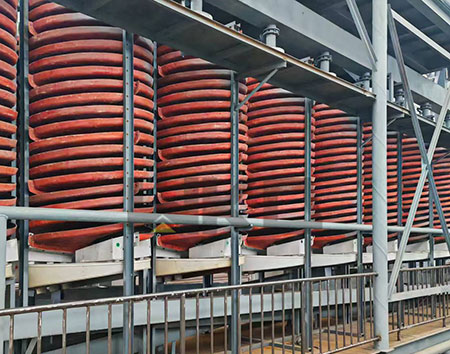
III. Cleaning with Shaking Table
The rough concentrate obtained from the spiral chute usually contains various heavy minerals like zircon and ilmenite. To further increase the cassiterite grade, shaking tables are used for precise separation. Utilizing an asymmetric reciprocating motion combined with lateral water flow, the shaking table achieves efficient separation based on mineral density differences, ultimately producing a tin concentrate.
IV. Purification by Magnetic Separation
The concentrate from the shaking table may still contain some weakly magnetic impurities, such as ilmenite. These can be removed using a three-disc magnetic separator for purification. By precisely adjusting the magnetic field intensity, these magnetic minerals are effectively separated, further enhancing the quality of the final tin concentrate.
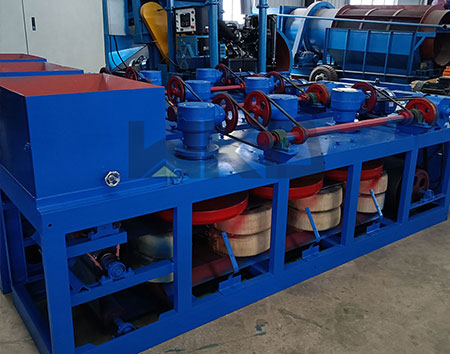
In summary, the beneficiation of coastal sand tin ore primarily relies on gravity separation, with magnetic separation serving as a supplementary method for concentrate purification.