

Nigeria's ilmenite resources are primarily hosted in coastal placer deposits along its southern coastline, widely distributed from Lagos State to Rivers State. These deposits were formed by the long-term weathering of primary rocks, followed by wave transport, sorting, and sedimentation. They are characterized by large reserves, unconsolidated structure, and convenient mining conditions. The following example is based on a coastal sand beneficiation plant in Lagos State, Nigeria. This production line focuses on ilmenite recovery and can process up to 500 tons of raw ore sand per hour.
Raw Ore Characteristics
The coastal sand deposit in this mining area is hosted in coastal zone sedimentary layers, with an ore layer thickness of 3-10 meters and an ilmenite grade of approximately 8-15%. In the ore, ilmenite is often closely associated with heavy minerals such as zircon, rutile, and monazite, while also containing a large amount of light gangue like quartz sand. The raw ore contains a certain amount of clay, organic matter, and a small amount of gravel, requiring pretreatment before separation.
Detailed Explanation of Nigeria's Ilmenite Beneficiation Production Line
1. Washing and Screening
The raw ore is fed by a feeder into a GT series trommel screen for washing and screening. The trommel is equipped with a high-pressure spray system and internal lifters. During rotation, it effectively breaks down clay, washes away surface coatings on minerals, and discharges gravel larger than 30mm from the end, producing clean fine-grained ore sand. This creates favorable conditions for subsequent gravity separation.
2. Spiral Chute Roughing
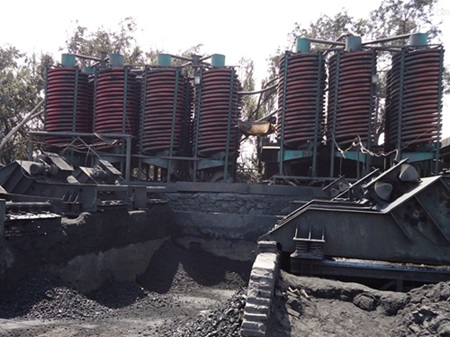
The undersize slurry from screening is evenly pumped by a sand pump to two sets of 5LL-2000 spiral chutes. Utilizing the density difference between minerals and the combined effects of centrifugal force and water flow, heavy minerals such as ilmenite and zircon concentrate along the inner edge of the chute, while a large amount of light quartz sand is discharged as tailings. This stage can remove about 80% of the gangue, achieving preliminary enrichment of heavy minerals.
3. Shaking Table Cleaning
The rough concentrate from the spiral chutes is pumped to 6-S type shaking tables for cleaning. By adjusting the deck stroke, frequency, and cross slope, and through the asymmetrical reciprocating motion and lateral water flow washing, residual low-density impurities are further removed, enriching heavy minerals like ilmenite to produce qualified heavy sand concentrate.
4. Magnetic Separation
The shaking table concentrate is dewatered and dried, then fed into a three-disc belt magnetic separator. By precisely adjusting the magnetic field strength of the front, middle, and rear discs, ilmenite, monazite, and tantalite-columbite can be sequentially separated.
5. Electrostatic Separation
The non-magnetic material, primarily a mixture of zircon and rutile, enters a high-tension electrostatic separator for separation. In the high-voltage electrostatic field, the more conductive rutile quickly adheres to and is carried away by the roller due to charge adsorption, while the less conductive zircon falls into another hopper, achieving precise separation between the two.
After the above process, high-quality ilmenite concentrate with a TiO₂ grade exceeding 52% can be obtained, suitable for direct use in titanium dioxide production and titanium metal smelting. Simultaneously, by-products such as zircon, rutile, and monazite are comprehensively recovered, significantly enhancing the economic benefits of the beneficiation operation.