

As the primary form of gold resources, rock gold ore boasts large reserves and wide distribution. However, its mining and beneficiation processes are relatively complex. How can the recovery rate of rock gold ore be improved? The key lies in optimizing crucial stages such as crushing, grinding, gravity separation, and flotation.
I. Multi-Stage Crushing While Avoiding Over-Crushing
Run-of-mine ore first enters the crushing stage, typically adopting a two-stage crushing process. Jaw crushers are recommended for primary crushing due to their powerful crushing force, which efficiently breaks down rock gold ore. For secondary crushing, cone crushers are used. Utilizing the laminated crushing principle, this equipment produces a uniform product size with a low over-crushing rate, providing suitably sized feed for subsequent grinding and facilitating the adequate liberation of the gold minerals.
II. Wet Grinding for Full Gold Mineral Liberation
Grinding is a core stage affecting gold recovery. Overflow ball mill are employed for wet grinding, using the impact and abrasion of steel balls to reduce the ore to approximately 200 mesh. To precisely control the product fineness, ball mill are often paired with spiral classifiers to form a closed-circuit cycle. This system promptly separates the qualified particle size, prevents over-grinding, ensures the full monomeric liberation of gold minerals, and creates favorable conditions for separation.

III. Multi-Pass Gravity Separation to Recover Gold of Various Sizes
Gravity separation is a primary process for rock gold beneficiation. Commonly used equipment includes jig machine, vibrating sluice box, and centrifugal concentrator.
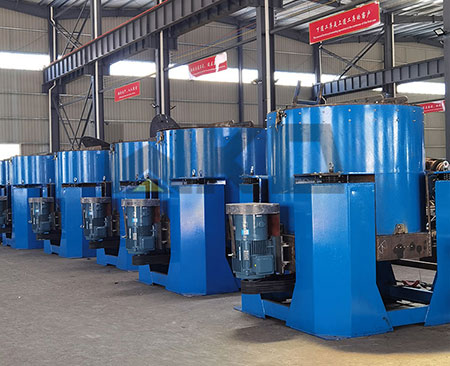
Jigs achieve rapid settlement and enrichment of coarse gold through pulsating water flow. vibrating sluice box are suitable for treating jig tailings, using mechanical vibration and water flow to recover fine gold. Centrifugal concentrator utilize a rotating drum to generate strong centrifugal force, significantly improving the recovery rate of ultra-fine gold. Adopting multi-pass gravity separation expands the recoverable size range, minimizing gold loss to the greatest extent.
IV. Rational Application of Flotation for Refractory Ores
For oxidized rock gold ores or gravity separation tailings, flotation serves as an important supplementary method. Mechanical agitation flotation machines use reagents to adjust the hydrophobicity of mineral surfaces, enabling selective attachment of gold particles to air bubbles and their subsequent flotation. This achieves efficient separation of gold from gangue minerals and is particularly effective for recovering disseminated and impregnated gold.
Improving the recovery rate of rock gold ore requires attention to the key stages mentioned above.