

Coastal sand is one of the primary sources of chromite and is typically associated with minerals such as ilmenite, zircon, monazite, and garnet. The beneficiation of coastal sand chromite ore primarily employs a combined process of gravity separation, magnetic separation, and electrostatic separation. This method offers high recovery rates, environmental friendliness, and relatively low costs.
The beneficiation process of coastal sand chromite ore is as follows:
Ⅰ.Washing and Screening
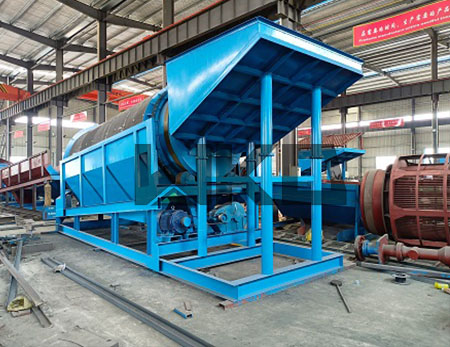
The raw ore extracted often contains impurities such as shells and mud. A trommel screen is used for washing to remove large waste rocks, resulting in relatively uniform ore sand particles suitable for subsequent gravity separation.
Ⅱ. Roughing
The core of this stage is to separate chromite from gangue minerals based on density differences. Chromite has a high density (approximately 4.0-4.8 g/cm³), while quartz, the main gangue mineral, has a lower density (approximately 2.65 g/cm³).
Spiral Chute: The ore slurry is fed into a spiral chute. Under the combined effects of gravity, centrifugal force, and water flow, high-density chromite and other heavy minerals tend to accumulate on the inner side of the chute and are discharged as heavy sand (rough concentrate). Low-density light minerals are carried away by the water flow from the outer side and discarded as tailings.
Ⅲ.Cleaning
Shaking Table: The heavy sand product obtained from the spiral chute is further fed into a shaking table for separation. Through asymmetric reciprocating motion and lateral water flow on the bed surface, the shaking table precisely separates minerals by density and particle size, yielding higher-grade chromite rough concentrate while simultaneously separating some other heavy minerals.
Ⅳ.Magnetic Separation
The rough concentrate obtained from gravity separation is a mixture of various heavy minerals, including chromite, ilmenite, zircon, and garnet. Separation is required based on differences in their magnetic and conductive properties.
Magnetic separation is a key step for separating chromite. A three-disc belt magnetic separator is used for strong magnetism to separate weakly magnetic minerals such as ilmenite and chromite from non-magnetic minerals like zircon and monazite. The magnetic separation product mainly consists of a mixture of chromite and ilmenite.
Ⅴ.Electrostatic Separation
Since chromite and ilmenite have relatively similar magnetic properties, a high-voltage electrostatic separator is used to separate them based on differences in conductivity. The more conductive mineral (ilmenite) is carried away by the roller, resulting in chromite concentrate.
By combining gravity separation, magnetic separation, and electrostatic separation, chromite concentrate is recovered while comprehensively recycling other valuable minerals, achieving the full utilization of coastal sand resources.