

The beneficiation of rare earth minerals from coastal sands employs a combined gravity-magnetic-electrostatic process. This flowsheet not only enables the efficient extraction of rare earth minerals like monazite but also allows for the comprehensive recovery of various valuable minerals such as zircon and ilmenite, offering significant economic benefits.
I. Trommel Screen Pre-treatment
The raw ore is first fed into a trommel screen for washing and screening. This equipment effectively removes impurities like clay and organic matter, and screens out coarse particles, providing uniformly sized material for subsequent separation.
II. Spiral Concentrator Roughing
The pre-treated sand is processed by spiral concentrators, which separate minerals based on density differences. High-density minerals such as rare earth minerals and zircon are concentrated along the inner groove and directed to the concentrate launder, while low-density gangue is washed away with the water flow, achieving initial concentration.
III. Shaking Table Cleaning
The rough concentrate from the spiral concentrators undergoes further refinement on shaking tables. Through vibration and lateral water flow, heavy minerals like monazite and zircon move towards the concentrate end and become enriched, while lighter gangue is carried away, significantly upgrading the concentrate grade.
IV. Three-Disc Magnetic Separation
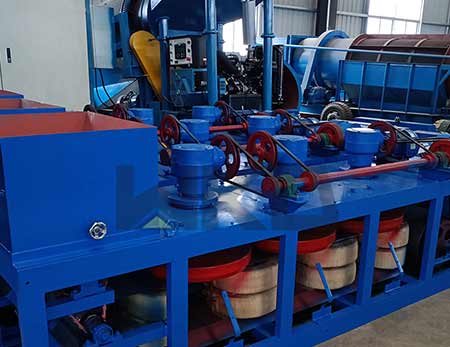
The shaking table concentrate is separated using a three-disc magnetic separator. By adjusting the magnetic field intensity, weakly magnetic minerals like ilmenite and monazite can be separated. The non-magnetic fraction constitutes a mixed concentrate of zircon and rutile.
V. High-Tension Electrostatic Separation
The mixed concentrate of ilmenite and monazite is fed into a high-tension electrostatic separator. Separation is achieved based on differences in electrical conductivity, ultimately yielding high-grade rare earth concentrate.