

Jig machine stands out due to its unique working principle and exceptional performance in recovering gold, making it a preferred choice for many mining operations.
I. Why Are Jig Machines Suitable for Placer Gold Beneficiation?
Placer gold deposits typically consist of a mixture of gold particles, gravel, clay, and other heavy minerals. A key characteristic is the significant difference in density between gold and waste rock (e.g., quartz sand). Gold has a much higher specific gravity than the surrounding gangue minerals. The jig machine is a gravity separation device that precisely utilizes differences in mineral density for beneficiation.
Its working principle is as follows: A drive mechanism (usually a crank-link or cam system) creates a vertically alternating, variable-speed water flow in the jig chamber. In the rising water current, dense gold particles "lag," while lighter particles (waste rock) are pushed upward. During the downward water flow, heavy minerals settle to the bottom of the jig faster than light minerals. After repeated pulsations, heavy minerals (gold particles) concentrate in the bottom layer, and light minerals remain in the upper layer, achieving efficient separation.
This separation method, based on physical density differences, perfectly matches the characteristics of placer gold deposits, making the jig machine an ideal choice for capturing fine gold particles, even those invisible to the naked eye.
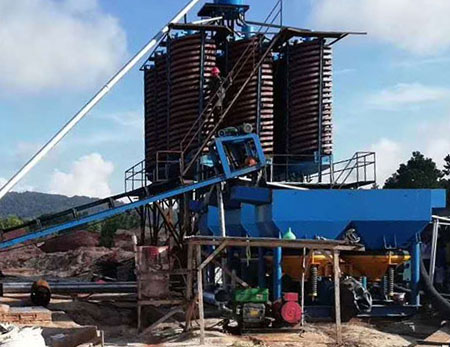
II. Core Advantages of Using Jig Machines for Placer Gold
High Recovery Rate: Especially effective for recovering granular and flaky gold, capable of capturing gold particles ranging from several dozen millimeters down to 0.1 mm or even finer. The recovery rate is significantly higher than traditional equipment like sluice boxes.
Large Processing Capacity: Modern jig machines feature advanced designs, allowing a single unit to process substantial volumes of raw ore. This makes them highly suitable for the continuous, large-scale production needs of medium and large placer gold processing plants.
Low Operating Costs: Jig machines have a relatively simple structure, low power consumption, few wear parts, and easy maintenance, significantly reducing long-term operating costs and labor intensity.
Environmentally Friendly: Jig concentration primarily relies on water flow and gravity, typically requiring no chemical reagents, minimizing environmental impact and simplifying subsequent wastewater treatment.
Jig machines can serve as primary roughing units to quickly discard large volumes of tailings, reducing the load on subsequent cleaning stages. They can also be easily combined with vibrating screens, spiral chutes, shaking tables, and other equipment to form an efficient placer gold beneficiation production line.
III. How to Select the Right Jig Machine?
Selecting the appropriate jig machine is crucial for success. Key factors to consider include:
Ore Properties: Analyze the particle size distribution, clay content, and dissemination characteristics of gold particles in the placer deposit. Washing may be necessary beforehand for clay-rich ores.
Processing Capacity: Choose the jig model and quantity based on the estimated daily processing volume of ore.
Particle Size Range: Different jig models have optimal processing size ranges (e.g., coarse particle jigs, fine particle jigs). Selection should match the gold particle size distribution in the raw ore.